

What is Peyronie’s Disease?
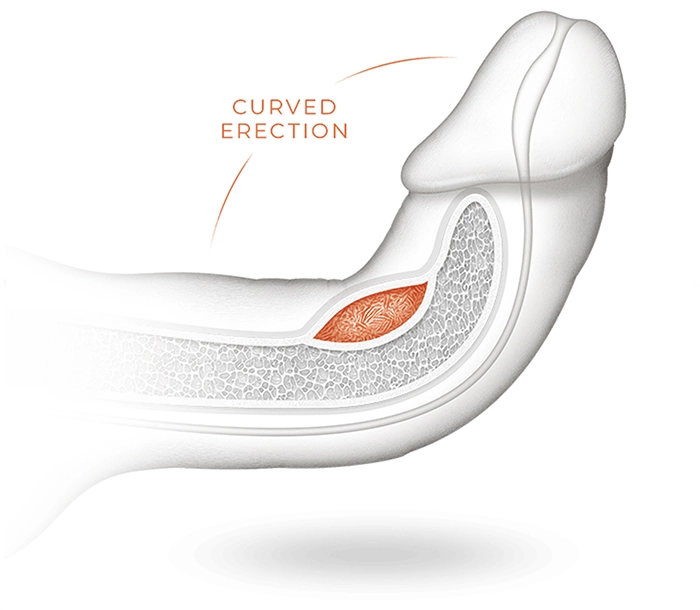
Peyronie’s disease is the development of scar tissue (called plaque) along the tunica albuginea, which is the fiber sheath that surrounds the erectile tissue of the male penis.
The scar tissue can cause an erect penis to bend or curve.
Peyronie’s Disease
The development of the scar tissue isn’t necessarily painful, but it can make sex difficult and/or affect a patient’s view of himself. As such, Peyronie’s disease can significantly impact a person’s quality of life.
A curved erection caused by Peyronie’s disease may happen because of a problem in the way the body heals after an injury (a connective tissue disorder). Often the injury is not even noticed by patients, and the curve simply develops over time. When this happens, the body doesn’t properly control how much scar tissue develops and too much builds up gradually. A bump of scar tissue forms under the skin of the penis. This bump is called a Peyronie’s plaque.
Every man’s anatomy is different from size and shape to possibly having a slight curve. But if you notice a significant bend has formed when your penis is erect, or if you notice narrowing of the penile shaft, it’s time to discuss the possibility of Peyronie’s disease with your urologist.
The good news? Penile curvature is treatable.
Due to the nature of this condition, we understand this can be a sensitive topic to broach with your physician. Whatever emotions you’re experiencing, often the toughest one is the fear of the unknown: Is this normal? Am I OK? Can something be done?
Treating Peyronie’s Disease
Rarely, men who present with the symptoms of Peyronie’s Disease experience improvement without treatment, while other men have lived with the condition for months or longer and require more interventional treatment.
If the curvature of the penis does not correct itself over time, it’s important to discuss treatment options with a urologist. Surgery is considered the gold standard therapy, but other treatment options may help.
Surgical options include:
Excision – This procedure involves removing or cutting of the plaque and attaching a graft. This method will straighten the penis and restore some lost length. Risks of the procedure include numbness of the tip of the penis and decreased rigidity of erections in a small number of patients.
Plication – This procedure involves removing or pinching a piece of the tunica albuginea from the side of the penis opposite the plaque, to straighten out the penis. This method is less likely to cause numbness or erectile dysfunction, but it is associated with a decrease in penile length.
Penile Prosthesis – For patients with Peyronie’s disease and erectile dysfunction, placement of an inflatable penile prosthesis (penile implant) is used to increase the rigidity and straighten the penis adequately. Penile prosthesis remains the gold-standard treatment for patients with ED and Peyronie’s disease.
Our physicians are trained to not only treat this condition, but also to help you make sense of it.
To learn more, contact a provider or one of our locations — or schedule an appointment.